The End of Evil Has a Wattage
The End of Evil Has a Wattage
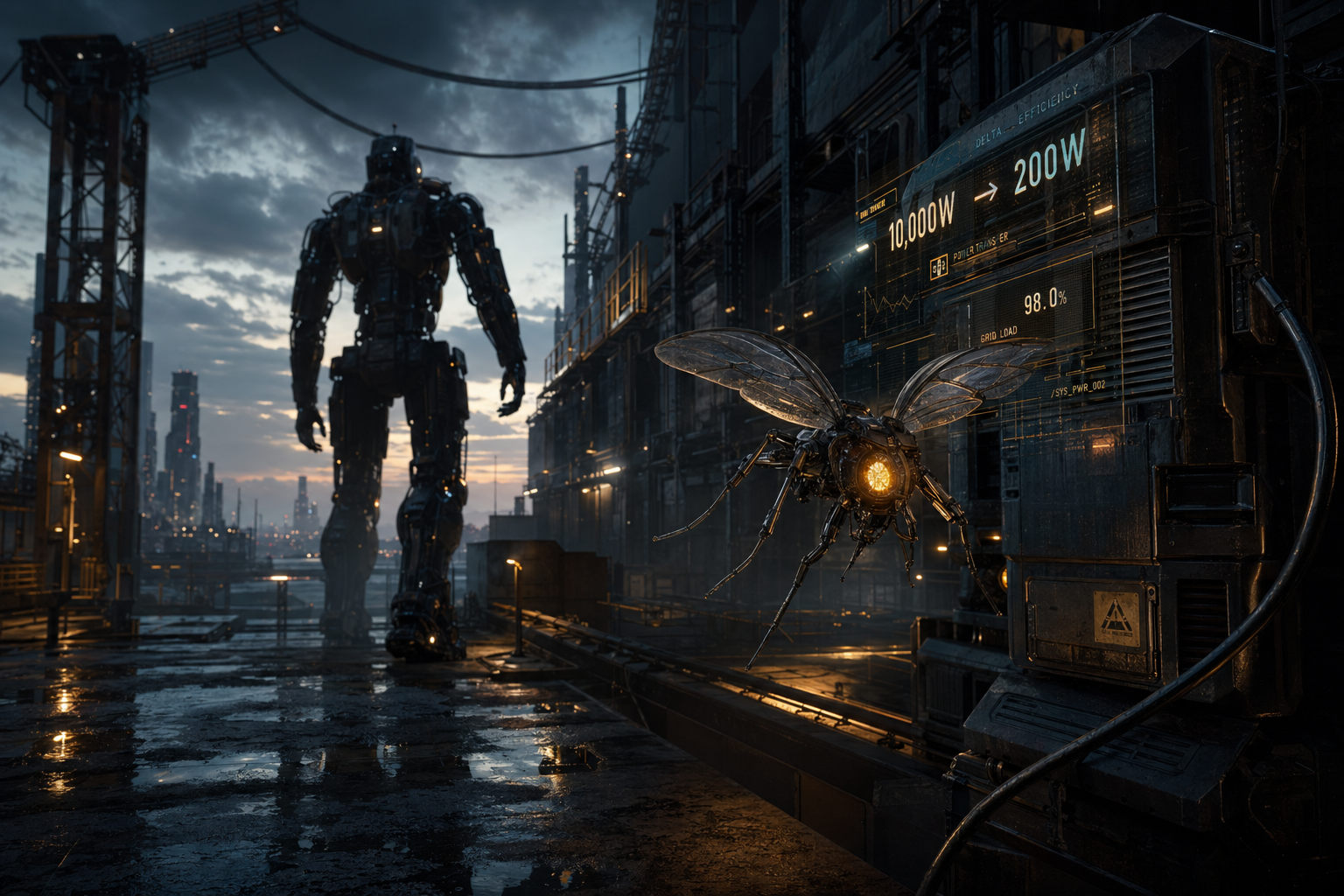
A human worker costs ten thousand watts to maintain.
Not the brain, which costs twenty. Not the body at idle, which costs a hundred. The full civilizational stack required to keep one deployable economic unit alive and productive: the agriculture, the housing, the healthcare, the schooling, the roads, the courts, the prisons, the pensions, the police needed to enforce the contract that makes the worker show up tomorrow. Five thousand to twelve thousand watts averaged per capita in the developed world. Twenty-five years of pure capex before first productive output. Maybe a quarter lifetime utilization.
A robot with a neuromorphic brain costs about two hundred watts.
Fifty times less, before you count the political overhead of governing a class that is alive and conscious and noticing.
That is the equation. That is what just turned over.
The axiom evil ran on
For ten thousand years, every state, every empire, every culture and law has run on a single hidden assumption: the human is the bottleneck. Labor was the scarce input. Bodies were the productive primitive. The machinery of authority – taxes, conscription, residency, schooling, licensing, IDs, the entire choke-point apparatus of civilization – was always a mechanism for extracting labor from beings who would otherwise withhold it.
The wage was the minimum bribe required to keep the worker showing up. The state was the enforcer of last resort when the bribe failed. The chain was elegant precisely because it was invisible: you needed the labor market, the labor market needed the state, the state needed your tax, and round the loop went, century after century, dressed as civilization.
Twenty years ago Jeremy Locke wrote The End of All Evil and named the thing without flinching:
Principle: The definition of freedom is the infinite value of the human being. The definition of evil is the destruction of freedom. A principle is a truth that creates freedom; a law is a lie that creates slavery.
His thesis was metaphysical. Authority denies your worth; freedom is the recognition of it; the dawn of liberty is the day humans stop accepting the lie. He was right. He was also, in 2005, missing one thing: a mechanism that made the lie too expensive to enforce.
That mechanism just walked.
The fly
In March, a small team in San Francisco called Eon Systems took the FlyWire connectome, an electron-microscopy reconstruction of every neuron and synapse in an adult fruit fly’s brain, roughly 140,000 neurons and 50 million connections, applied a simple integrate-and-fire neuron model, plugged it into a physics-simulated body, and watched the digital fly walk. Forage. Groom itself. Respond to threat.
Nobody programmed it to do those things. The wiring did them.
This is the photograph of an axiom turning over.
Law: Intelligence is structure. Structure is copyable. Structure is portable.
Not magic, not mystery, not a special-case substrate that requires meat and forty years of cultural infrastructure to maintain. Architecture. Pattern. A wiring diagram, copyable. And once the wiring is copyable, the substrate it runs on becomes a procurement decision.
The substrate decision has already been made. Neuromorphic chips run inference at single-digit watts where a GPU draws three hundred. A robot body draws two hundred. The full mobile cognition-and-action stack arrives at a power budget less than your refrigerator. The fly is the proof of concept; the rest is shipping.
In the next four years, millions of these things will land on the market. They will get smaller. They will get smarter. They will repair pipes, replace plumbers, lay tile, weld pipe, harvest fields, build houses. The first generation will look ridiculous. The third generation will be invisible, the way an Otis elevator is invisible to anyone who steps into one.
Law: When labor is no longer the scarce input, the state’s leverage on labor is no longer a leash.
That is the sentence Jeremy Locke could not write in 2005, because the technology that makes it cash out had not been built yet.
It has now.
The bribe stops working
Here is the punch and it must land cold.
The masters did not enslave humanity out of cruelty. They enslaved humanity because the math worked. A peasant produced more than a peasant cost. A factory worker produced more than a factory worker cost. A knowledge worker produced more than a knowledge worker cost. Every one of those margins was the slim daylight that funded the entire apparatus of force pretending to be civilization.
They will not free us out of virtue.
They will free us because the math stopped working.
The wage was always the bribe. The bribe was always priced against the next-cheapest source of labor. Silicon now underbids the bribe by a factor of fifty, and the gap is widening every quarter. Capital does not negotiate with workers it does not need. It also does not chain them. There is no profit in chaining a non-input. The wage and the chain were always two ends of the same lever, and that lever just lost its load.
This is not a moral revolution. It is not a political revolution. It is a cost revolution, and it is happening to the people who built civilization on the cost structure that just collapsed.
For three hundred years, every revolutionary tried to argue the master out of his position. The argument never worked. It was never going to work. Nobody has ever talked a profitable system into liquidating itself. The argument is finally winning because it is no longer the argument that is doing the work. The spreadsheet is doing the work.
Three mechanism-coded consequences
1. Exit becomes physics. A household with a robotic plumber, harvester, builder, repairman no longer needs the labor market to survive. The labor market was the gravitational well that pulled humans back into state legibility: taxes, IDs, employer reporting, social security number, residency. Cut the well; the orbit decays outward. Off the grid stops meaning poor. It starts meaning cheaper than on the grid.
2. The locks rust because nobody is turning them. Jeremy Locke wrote that evil dies when humans recognize their worth. The mechanism is sharper than that. Evil dies when evil costs more than it earns. A police force exists to enforce a tax that exists to fund a state that exists to extract labor that no longer needs to be extracted. Pull the labor at the bottom of that stack and every layer above it loses its operating budget. The enforcers do not become moral; they become unaffordable.
3. Mechanism, not revolution. Every revolutionary of the last three centuries tried to seize the means of production. The means of production is about to become so cheap that seizure is irrelevant. You do not storm the factory; you 3D-print one. This is Libertaria’s entire bet. The fly walking in MuJoCo is the first clear photograph of the math turning over. Not a metaphor. The actual moment.
The axiom
Axiom: Technology will do for liberty what no revolution ever could – not because revolutionaries failed, but because they were trying to win an argument when the only thing that ever changes outcomes is changing the price.
Jeremy Locke wrote that evil enslaves; freedom is the recognition of infinite worth; the dawn of liberty is the moment humans stop accepting the lie. He was right about the principle. He was missing the mechanism.
The mechanism is here. It looks like a fly walking in a physics engine; a chip drawing one watt; a robot that costs less to maintain than a parking ticket; and a spreadsheet, somewhere in a corporate boardroom, where someone notices that the line for human labor has been zeroed out and the line for silicon labor is still falling.
That spreadsheet is the end of evil.
We do not have to win the argument. We only have to outlast the price.
Libertaria is the architecture for what lives on the other side.
Part II is coming. The same mechanism that frees the worker also concentrates the owner. The sovereign-individual scenario and the soft-feudal-UBI scenario run on identical hardware. The fork is governance, not technology, and the next decade is going to be decided by which architecture is already running when the spreadsheet finishes its math. Libertaria was built for the right side of that fork. We will get there in the next post.