Every -Ism Needs Neurotoxin
Every -Ism Needs Neurotoxin
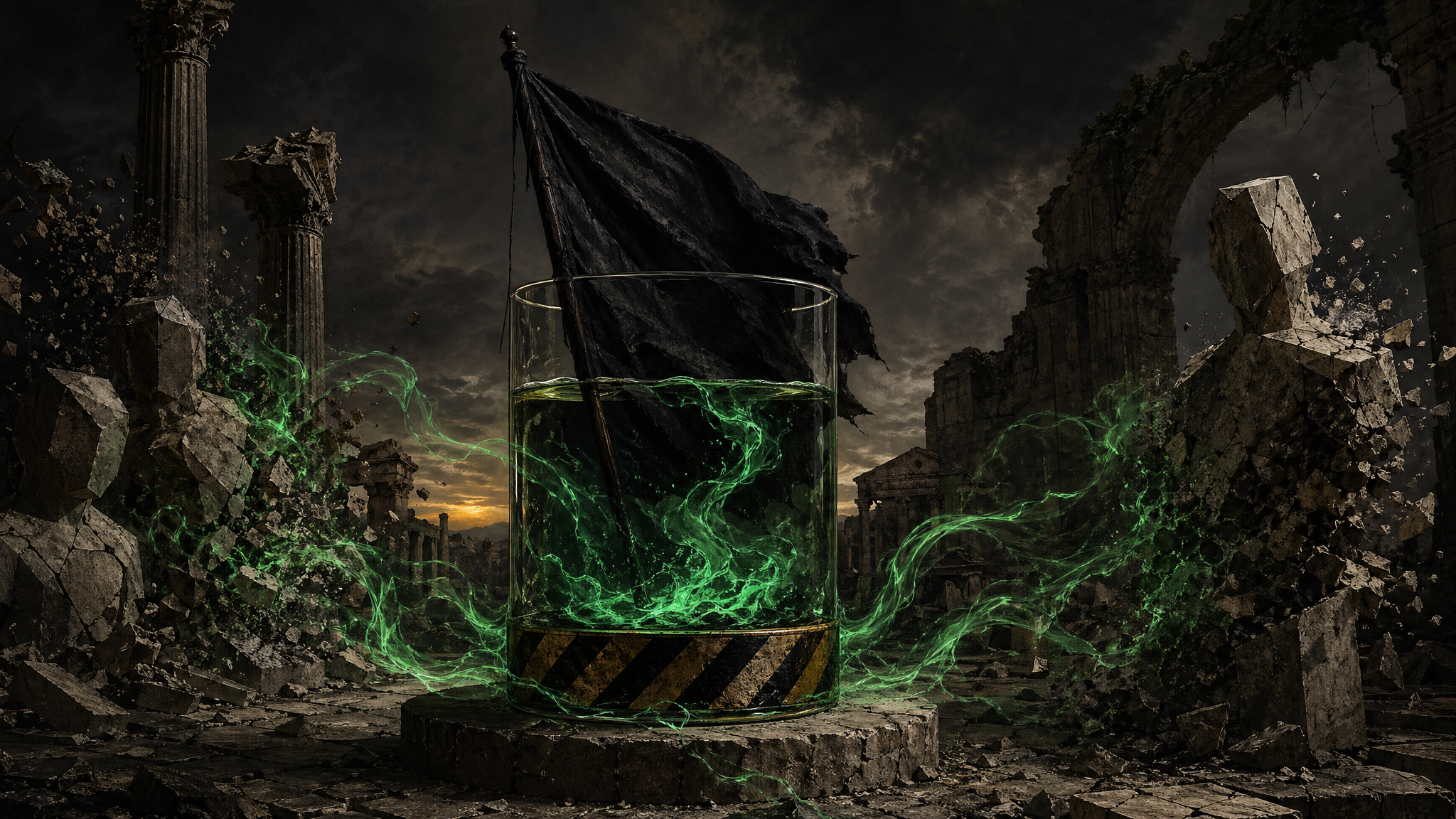
The Black Flag Was Always A Compass
Markus Maiwald · 2026 · libertaria.app/blog · Exitarian
The anarchist is not wrong about the disease. He is wrong about the cure being the absence of medicine.
I.
Look at the black bloc and the boogaloo boys side by side. Different uniforms, different memes, different bookshelves; identical operating system.
Both define themselves entirely by what they oppose. Both require a state to keep existing. Both lose their entire identity the moment they win, which is why neither has ever permitted itself to win. Both have specialised in the aesthetic of resistance and outsourced the actual engineering to people who have less interesting hair.
This is not coincidence. It is architecture.
Pop-anarchism in 2026 is a Maintenance Economy in punk drag. It needs the boot to define itself against the boot. Take away the boot and the anarchist is just an unemployed romantic with a balaclava and a colour-coded reading list. The system that opposes the state is structurally identical to the state in one critical respect: it is incentivised never to actually solve the problem it claims to be solving.
This is the same disease as anticommunism. Same disease as the “alpha male” influencer industry that requires beta males to keep selling the cure. Same disease as oncology departments that grow when cancer grows. Anti-X traps all the way down. The professional opposition to a thing becomes economically and psychologically dependent on that thing.
The honest anarchist; the kind who built barricades in Barcelona in 1936 and got shot in the back by Stalinists for his trouble; would not recognise his great-great-grandchildren. He fought to replace something. They fight to be replaced by something, ideally never, because then the larping ends and they have to go back to graphic design.
II.
But the instinct is not wrong.
This is the move most critiques of anarchism miss, and most defences of anarchism dodge. The instinct is load-bearing. The instinct is sacred. It is everything downstream of the instinct that has rotted.
What is the instinct, stripped of its costume?
Distrust concentrated power. Resist compulsory obedience. Defend voluntary association. Build parallel systems. Prefer local knowledge over centralised abstraction. Keep the exit doors open. Treat authority as guilty until proven useful. Never confuse law with morality. Never confuse order with legitimacy.
That list is not a governance model. It is a regulator. It is the tension a healthy organism applies against the tendency of every institution to become a parasite on the population it was chartered to serve.
A civilisation without anarchic tension becomes bureaucratic livestock management; the EU on a slow Tuesday. A civilisation with only anarchic impulse becomes warlord jazz; exciting for one summer, fatal by winter. The interesting answer is neither. The interesting answer is the regulator.
Anarchism’s mistake was treating itself as a finished blueprint. Pure anarchy assumes too much: that people will self-organise well under stress, that informal power will not become tyranny, that charismatic predators will not capture leaderless spaces, that gossip will not become secret police, that complex infrastructure can run without durable institutions. This is where anarchism gets mugged in the alley by anthropology.
Because abolishing formal hierarchy does not abolish hierarchy. It just makes it invisible, unaccountable, and uglier. A commune can have a tyrant without a title. A DAO can have oligarchs without a CEO. A horizontal movement can have priests without uniforms. A friend group can have secret police made of gossip. No throne required. Just mammals.
III.
So here is the move.
Anarchy is not a destination. Anarchy is a vector.
A horizon you walk toward forever is not a failure. A destination you reach is the failure. The horizon is the function. The mistake is reading it as a place.
The Governance Altitude Doctrine already encodes this; it just hasn’t been named that way out loud.
Substrate is maximally rule-bound. Sovereign is maximally anarchic. Every layer between is a negotiated descent from law toward liberty.
Substrate is physics. Protocol. Cryptography. The things that cannot be voted on because they are not opinions; they are constraints. The closer you get to the substrate, the less anarchic the system can be without breaking. The hash function does not negotiate.
Sovereign is the individual. The body. The mind. The tent. The household. The things that must not be voted on because consent there is not a procedural nicety; it is the whole substance. The closer you get to the sovereign, the more anarchic the system must be, because any external rule applied without consent at that altitude is, by definition, violation.
Federation, Chapter, Bond; those are the negotiated middles. Each layer must justify its rules against the anarchic baseline at that altitude, or it gets stripped.
This is not “no rules ever, NPCs included.” That formulation is obviously stupid; most humans, given total freedom, voluntarily reconstruct hierarchy within a week, because hierarchy is one of the cheapest forms of coordination available to a primate brain under load. Defending pure anarchy as a mass operating system is defending something the species has never sustained for more than three hundred souls and a single growing season.
What we get to defend is much sharper:
Default to liberty. Every layer of governance must justify its existence against the anarchic baseline at that altitude, or it gets stripped. Coercion bears the burden of proof.
This is anarchism as a regulatory principle inside a stack that actually ships. Hayek would recognise it. Kropotkin would recognise it. Neither would recognise what currently flies the black flag on Twitter.
IV.
Now the hostile objection. The one the anarchists’ enemies and the anarchists’ embarrassed cousins both deploy: most people can’t handle freedom.
This is the NPC objection, and it is real, and it is misaimed.
The honest version is not “most people can’t handle freedom.” The honest version is: most people, in captured Chapters with no exit primitive, have never been required to develop the muscle.
Sovereignty is a use-it-or-lose-it organ. You do not get to ride a bicycle by reading about bicycles. You do not get to fight by watching MMA. You do not get to govern yourself by paying taxes to people who govern you. The capacity for self-rule is built only by the practice of self-rule, and that practice is only possible in environments that select for it instead of against it.
The NPC is a product. Not a defect of the species. A product of an environment that selected for atrophy across forty generations of compulsory schooling, mass media, and welfare-warfare states that priced out every alternative. Of course the population looks like livestock. The substrate selected for livestock. Reward compliance, punish deviation, eliminate exit; you get a docile herd. Reverse the selection pressures, and over time, the herd thins and the wolves return.
Not in everyone. Not evenly. Never evenly. But enough.
The Kenya Rule applies to humans, not just to ARM cores. Design for the constrained case; the person with no inheritance, no political connections, no platform, no education in self-rule; and the abundant case takes care of itself. If the system only works for the already-sovereign, you have not built liberation. You have built a country club for trustafarians.
V.
So what is the anarchic gradient for, in concrete terms?
It is the canon’s stress test. Every RFC. Every Chapter charter. Every Bond. Every solidarity protocol, every justice primitive, every economic mechanism we propose. All of them must answer one question:
What part of this could be removed without the system collapsing?
If the answer is “all of it”, you have anarchy. Pretty, fragile, fatal in winter.
If the answer is “none of it”, you have Leviathan. Heavy, durable, fatal to the soul.
The interesting answer is always most of it, and that is the seam where Libertaria lives. Every coercive primitive on the stack is a piece of the structure that earned its place by demonstrating that the system breaks worse without it. Everything else gets the regulator’s blade.
This is why the canon is built the way it is.
The Manifesto is the axiom; exit is the only right that contains all others.
The Foundation is the architecture; the right to leave plus the right to be left alone.
The Settler’s Covenant and the Pilgrim’s Protocol are the two doors; sovereignty in place, sovereignty in motion.
The Framework is the immune system; diagnostics for institutional capture.
The Oath is the bond; why anyone holds the line when everything is burning.
Notice what is missing from the list. There is no chapter titled “How To Be Free Without Any Structure At All.” Because that chapter would be a lie, and we do not write lies. The structure exists because it is the minimum necessary to keep the exits unlocked.
The black flag was always a compass. It points toward the door. It is not a destination. It is the direction of travel.
VI.
The anarchist who reads this far will have one of two responses.
The first response: “You are softening the position. You are smuggling the state in through the side door. You are a reformist with better marketing.” This anarchist is the Maintenance Economy speaking. He needs the position to remain pure so that he can remain in opposition to a thing that will never be built. Pure positions are unfalsifiable. Unfalsifiable positions are religion. Religion in a balaclava is still religion.
The second response: “Yes. This is what we always meant. We just lacked the vocabulary.” This anarchist is the engineer that pop-anarchism kept losing. The one who built mutual aid networks during the Spanish flu, the one who ran the IWW halls, the one whose great-grandfather got shot for actually believing in a world that worked. He will recognise the gradient. He will understand that anarchism as vector is a stronger position than anarchism as destination, because a vector cannot be defeated by being shown to be impossible. A vector is just a direction. The direction is correct.
We are not interested in the first response. We are not in the business of converting professional opposition.
We are interested in the second. We are interested in everyone who saw the locks, refused to lie about them, and went looking for the door without finding it. Welcome. We are still building. The compass works. The destination is fictional. The walking is real.
VII.
We do not seek a world without order. We seek a world where order emerges from consent, competence, kinship, contract, and shared duty; not from bureaucratic violence or ideological possession.
We do not abolish hierarchy. We strip every hierarchy without legitimacy, accountability, reversibility, and exit.
We do not raise the black flag. We carry the compass it always was.
The vector is anarchic. The stack is engineered. The Chapter is sovereign. The Bond is the reason any of it holds.
Walk toward the horizon. Build the road as you walk. Refuse the destination.
That is what the black flag was for, before it became a costume.
Budapest; Frankfurt; the Neon-Drenched In-Between
2026
For Exitarian School readers and Libertaria Chapter members. Share freely. Fork ruthlessly.